
Powered By



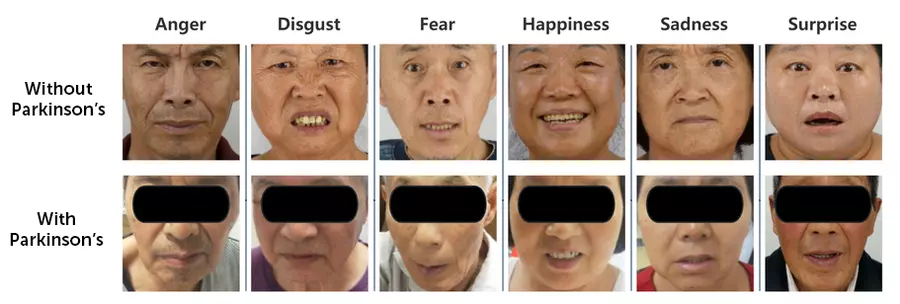
 Hypomimia, or facial masking, can make your face show less emotion than you’re actually feeling. With Parkinson’s disease, stiffness and slowness can affect the muscles in your face, making it harder to smile or show other expressions.
Because of this, other people may think you’re sad, uninterested, or upset when you’re not. That can sometimes lead to misunderstandings with family, friends, or others.
Here’s what to know about facial masking and what may help.
Sign up to view the results!
 Continue with Facebook
Continue with Email
Continue with Facebook
Continue with Email
Facial masking may make your face look less expressive during conversation. Stiffness and slower movement in facial muscles can make it harder to smile, raise your eyebrows, or show how you’re feeling.
Some people notice fewer spontaneous facial movements, such as smiling or blinking. Others describe a “stony face,” a flat affect, or a blank expression. These changes can be frustrating because they don’t necessarily match how a person feels inside.

Facial masking can sometimes make your face look droopy. However, a sudden one-sided facial droop isn’t typical of Parkinson’s and may be a sign of stroke. Call 911 right away if this happens.
Parkinson’s disease can also affect voice and speech. A softer or flatter voice, along with reduced facial expression, may make conversations more challenging.
Parkinson’s disease is a neurodegenerative movement disorder that can affect facial movement and expression in several ways.
Bradykinesia is the medical term for slow movement. Bradykinesia is related to low dopamine in the brain. You may think of bradykinesia as slowed walking or other movement, but it can also affect facial expression.
Muscle rigidity due to Parkinson’s also affects the face. Stiff muscles may make it harder to smile or raise your eyebrows the way you did before.
Cognitive changes from Parkinson’s disease may also make it harder to recognize and respond to other people’s facial expressions or other nonverbal cues.
People with Parkinson’s may experience mood changes or depression that can be hard to distinguish from facial masking. While facial masking can be mistaken for depression, facial masking doesn’t necessarily mean someone is depressed.
Speech changes, like speaking more softly or in a monotone, can make it even harder for others to understand how you’re feeling.
Facial masking can appear gradually and may change over time. Hypomimia symptoms can range from reduced blinking to more fixed facial expressions as Parkinson’s progresses.
A 2021 study found a connection between hypomimia and axial symptoms. Axial symptoms affect the body’s central axis and can include problems with posture, balance, and gait, including freezing.
Facial masking may become more noticeable as other motor symptoms progress.
The 2021 study also found a connection between facial masking and cognitive decline, though other studies have not found the same relationship.
Facial masking can make social interactions and communication at work more difficult. A small study of 40 people with Parkinson’s and their partners found that facial masking affected how partners experienced the relationship.

Caregivers in particular can struggle with their loved ones’ lack of expression. Here’s what some MyParkinsonsTeam partners and family members shared:
“The hardest thing for me is reading my partner’s facial expression. Does anyone else have this problem?”
“That is the worst thing for me. I haven’t been able to ‘read him’ for a couple of years now.”
Individuals with Parkinson’s can find it frustrating when people assume they’re upset when they’re not:
“Everyone always tells me to smile more or lighten up. They even say ‘Why do you always look mad?’ or ‘Why are you about to cry?’ when in actuality I’m in a perfectly good mood.”
“People always thought I hated them. After I was diagnosed and found this was a symptom, I looked in the mirror, and it suddenly made sense.”
“My face feels so stiff, and people say I don’t smile like I used to.”
In some cases, treatments for Parkinson’s disease may also help ease facial masking. Other strategies, like working with a speech-language pathologist or specialized rehabilitation programs, may help improve facial movements.
Levodopa is typically the first-line medication for Parkinson’s motor symptoms. This medication may also help with facial masking.
“My first symptom was masking, a stony face, and a flat affect where normal facial expression was missing,” shared a MyParkinsonsTeam member. “I began to have more normal facial expressions as soon as I began meds.”
Other treatments may also help with Parkinson’s motor symptoms. Your doctor can help you decide which options may be right for you.
A speech-language pathologist who works with people with Parkinson’s can help with facial masking through individualized facial movement exercises, cueing, or other therapy.
One member commented, “Some Parkinson’s-related exercise classes include practicing facial expressions to help overcome this symptom.”
The Lee Silverman Voice Treatment Loud program (LSVT LOUD) is a form of intensive speech and voice therapy to help people with Parkinson’s increase speech volume. LSVT LOUD may also improve facial expression, especially during speaking, but it isn’t a dedicated facial-masking treatment.
A few small studies have evaluated specialized facial masking therapy and found improvements in facial expression, but the evidence is still limited.
On MyParkinsonsTeam, people share their experiences with Parkinson’s disease, get advice, and find support from others who understand.
Has Parkinson’s affected your or your loved one’s ability to understand nonverbal cues or express emotion? Let others know in the comments below.
Get updates directly to your inbox.


Has anyone experienced their tongue darting out of their mouth after starting carbidopa/levadopa?


 Continue with Facebook
Continue with Email
Continue with Facebook
Continue with Email
Continue with Facebook
Continue with Email
Continue with Facebook
Continue with Email
Become a member to get even more





 Join
Join



 Your Privacy Choices

This is a member-feature!
Sign up for free to view article comments.
We were having lunch with some friends and they mentioned to my wife that I didn’t look like I was having a good time. Shortly afterwards I was diagnosed with PD, which explains what was happening.
We'd love to hear from you! Please share your name and email to post and read comments.
You'll also get the latest articles directly to your inbox.